Category: Insulin resistance

Is laminitis linked to rising temperatures?

Posted on: March 26, 2017

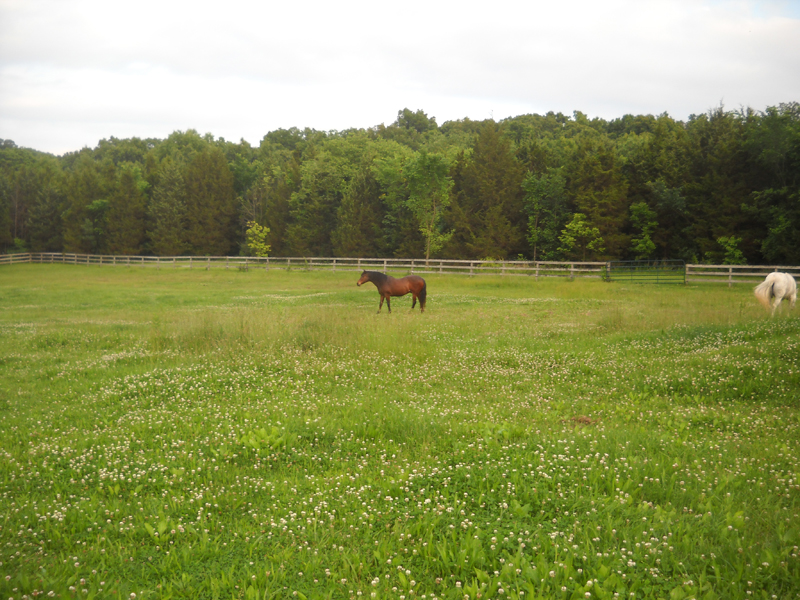
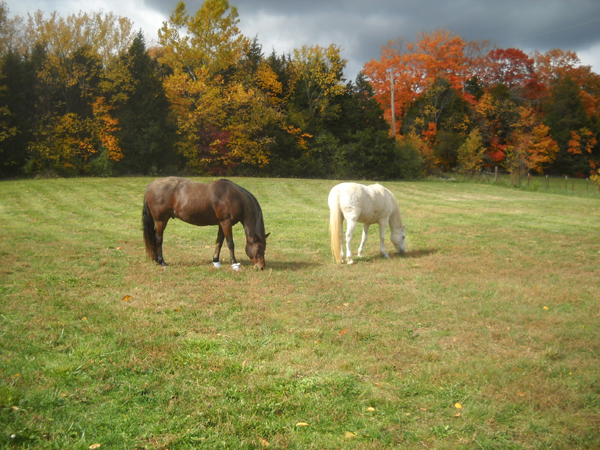
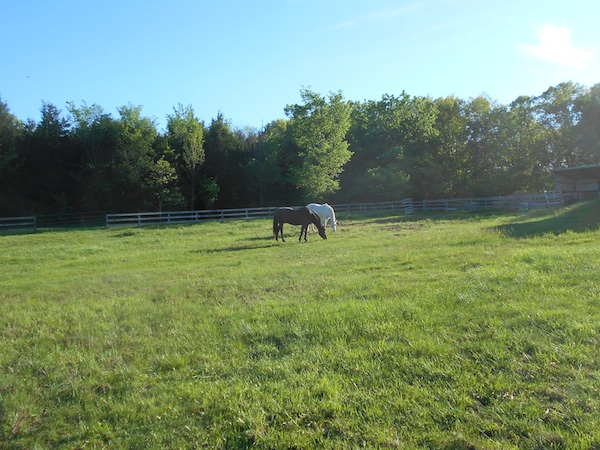
Robin and Kurt graze May 1, 2016. The heat and humidity of 2016 nearly killed these two laminitis horses.

Robin and Kurt graze May 1, 2016. The heat and humidity of 2016 nearly killed these two laminitic horses.

Post reviewed Sept. 13, 2026. Heat remains the biggest problem for my current laminitic horse. When I see extreme heat in the forecast, even in March, I set up his air coolers and fire up his fans to make sure I give him as much relief as possible.

There are many theories as to what is driving the insulin-resistant form of laminitis to record highs. The answer may be rising temperatures.

Researchers from The Netherlands published a study in March 2017 linking human diabetes to increased outdoor temperatures.

The researchers concluded that a 1 degree Celsius rise in temperature could account for more than 100,000 new diabetes cases in humans per year in the U.S. alone. The study appeared in the open access journal BMJ Open Diabetes Research & Care.

Laminitis is on the rise throughout the world, according to many sources. Equine veterinarians repeatedly have chosen laminitis as their biggest challenge on surveys. And an annual U.K. equine survey estimated in 2016 that laminitis ranked second in equine illnesses in the country, behind lameness in general, and accounted for 6.8 percent of illness.

The insulin form of laminitis far outpaces other forms of the disease.

The Netherlands study authors took note of recent data showing that patients with type 2 diabetes who were exposed to moderate cold for only 10 days improved insulin sensitivity. They attributed this improvement to cold exposure activating brown adipose tissue, which combusts large amount of lipids to generate heat.

The researchers described their study as the first to assess the association of outdoor temperature with diabetes incidence and the prevalence of raised fasting blood glucose on a national and global level. They used 14-year longitudinal state-level data from the U.S. and showed the overall diabetes incidence rate is higher in warmer years. For each 1 degree Celsius increase in temperature, they found an overall increase in diabetes incidence of 0.314 per 1,000.

The rest of this post initially described how the weather was getting warmer. Ten years later, the weather has definitely gotten warmer. Enough said.


Iron overload likely caused my horses’ laminitis

Posted on: July 12, 2015

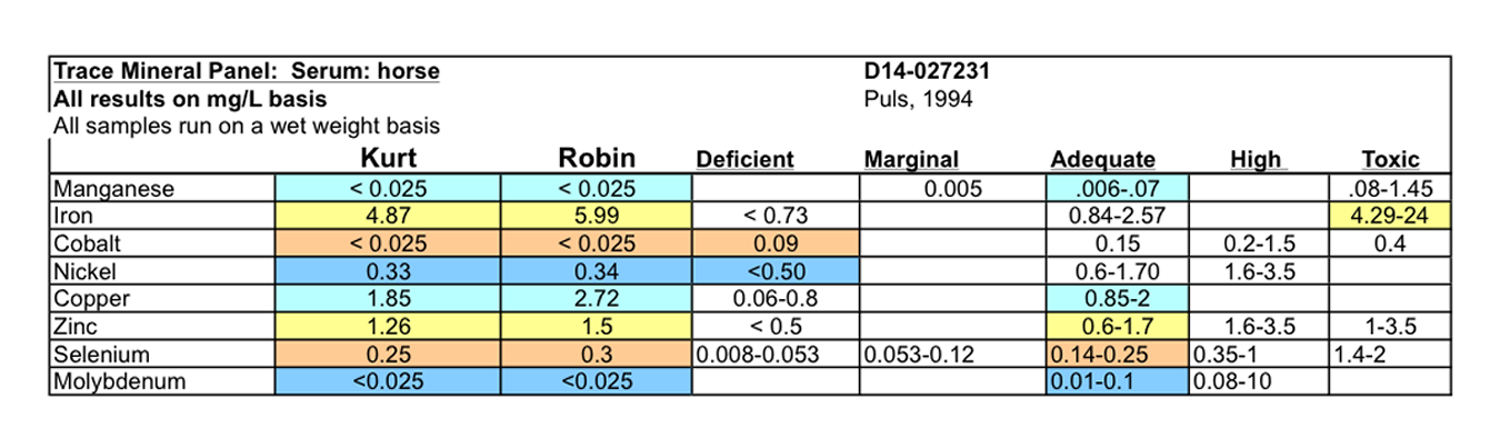
Toxicology test on horses' iron level

Toxicology test on horses’ iron level.

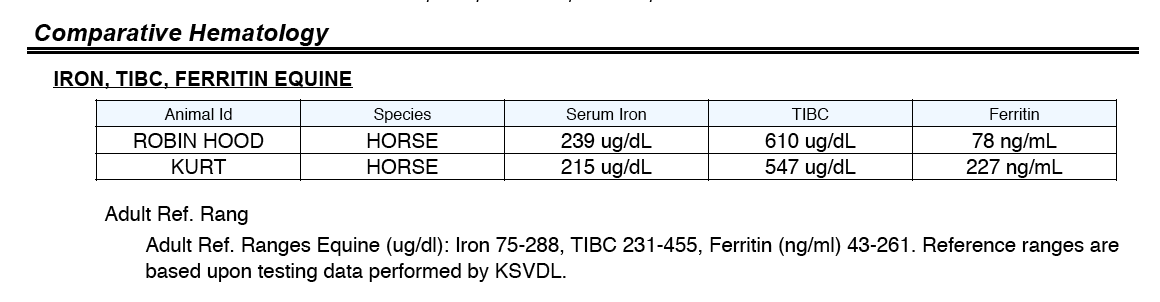
Hematology test on horses' iron level

Hematology test on horses’ iron level.

Post reviewed April 5, 2026.

In “Clue” like fashion, I’m declaring the cause of my six horses’ laminitis over the last 18 years as an excess intake of iron from weeds, trace mineral blocks and well water, leading to insulin resistance and the insulin form of laminitis.

The insulin resistance and laminitis were exacerbated by me following veterinary guidance to restrict the horses’ hay, keep the horses on dry lots and prevent the horses from eating so-called “lush grass.” I now believe these moves were the exact opposite of what was needed to get the horses’ metabolism functioning properly.

In the game of “Clue,” I’d get immediate confirmation of whether my assertion is correct. Unfortunately, with the laminitis, I will receive no such feedback.

But a cascade of events led me to this conclusion.

In October 2014, I needed to have my leaking well fixed (the water pressure was down considerably, and a pond had formed to the west).

But I also wanted to have my horses’ iron levels tested at Kansas State University’s lab. I suspected iron as the cause of the horses’ laminitis for a decade but had no proof.

A previous iron test done through the local zoo did not provide useful results.

Several experts recommended KSU for these tests (I’m not making such a recommendation at the moment). I was hoping to do a three-test panel of serum iron, TIBC and ferritin (a hematology test) and a serum trace mineral panel (a toxicology test). I admit I didn’t know what I was doing. I wanted some data.

There wasn’t enough money to do the tests and fix the well.

The iron tests for my two living horses totaled $400, including my vet’s fees. I chose to do the tests and hope for the best with the well.

My vet didn’t provide this iron test as a regular service but agreed to draw the blood if I did the mailing.

I sent the package in a vet-provided cooled envelope by overnight shipping on a Thursday. KSU said shipping on Thursday was fine as long as the package arrived Friday morning. I don’t know what happened to the package after it got under way. I don’t know when it arrived or was tested, and all may have gone as planned.

I received results from KSU that suggested my horses had toxic levels of iron (see images at top).

A university vet who provided comments on the tests said the toxic level “could be indicative of artifactual hemolysis” within the submitted sample. In other words, the blood got too warm or tainted in transit.

I talked to a lab person by phone, and the blood was indeed considered compromised.

I personally believed the results were correct as far as the horses having too much iron but couldn’t be sure, and I couldn’t do the tests again due to the cost.

I had my own iron level tested through a company I found online, Lab Corp, for considerably less money, and my iron level was normal, making me think the iron theory had come up short.

My sister told me my iron results did not seem normal, given that all the women in my family were anemic. She said I likely was anemic, too, and was being affected by the iron in the water.

Meanwhile, also in 2014, veterinarian Frank Reilly, a leading advocate for laminitic horses, posted on his website the iron levels of common pasture weeds. The iron levels are really high. Excess iron can fuel insulin resistance.

I knew my horses had been eating more weeds than anything else in recent years because I had intentionally ignored the grass, thinking that less grass was better. The grass went away, and the horses ate the weeds.

I was suspicious of the well water having too much iron, since the water turns everything rust colored and has eaten through the bottom of all my aluminum tanks. But I still didn’t have proof there. A water test in 2005 showed nothing suspicious.

I did find out that the horses’ trace mineral blocks were 25 percent iron, and I threw those away in 2012.

In November 2014, I emailed Dr. Reilly, asking how one might reduce the iron level in horses through supplements. He spent his Thanksgiving holiday investigating this idea. He emailed back that curcumin and ginkgo could reduce the iron level, and he provided suggested amounts and where to buy it. Purebulk.com sells the curcumin (250 grams, $70 at the time — it’s gone up). Reilly suggested feeding 1/2 tablespoon a day. Starwest Botanicals sells ginkgo leaf cut and sifted (1 pound bag). Reilly suggested feeding 1 tablespoon in the morning and 1 tablespoon in the evening.

After giving the horses the two supplements for a few weeks, I stopped because my gelding Kurt was breaking out in drenching sweats as we entered yet another frigid winter. We eventually figured out the sweats were caused by thyroid powder (no longer given).

Also, a friend had sent me a camping filter for the well head to filter out iron, but I don’t use the well head during the winter due to the hose always being frozen. I carry buckets of hot water outside. So I didn’t put on the filter.

All these things nagged at me, but polar vortex winters tend to keep one busy.

Everything came together in May 2015, when I finally had the well fixed, and a well company employee blurted out, “You must have an iron problem” when telling me how deep the well was. The casing is 350 feet deep (very deep) and collects iron all along the shaft, which gets transferred to the water as the water sloshes through, according to the well guy, an industry veteran.

The irony is not lost on me that fixing the well gave me more information than the iron tests.

Climate change may be causing laminitis

Posted on: July 12, 2015

This paddock changed from sand to grass over 18 years before erupting in weeds in 2015.

This paddock changed from sand to grass over 18 years before erupting in weeds in 2015.

Post reviewed April 5, 2026.

Climate change is having at least two effects on vegetation that may be increasing the incidence of laminitis in horses.

First, weeds are proliferating due to increased carbon dioxide, rain and heat in the atmosphere, according to scientists at Purdue University and France’s Climate-Environment-Society consortium in Europe.

The global concentration of carbon dioxide in the atmosphere — the primary driver of recent climate change — reached 400 parts per million (ppm) for the first time in recorded history in 2013, according to NASA data. It had climbed to 429 ppm by 2026.

One carbon dioxide expert (Dr. Charles Miller) said these CO2 values are more than 100 ppm higher than at any time in the last one million years (and maybe higher than any time in the last 25 million years).

Second, the increased acid in the atmosphere from coal plant and auto emissions is leading to higher acid in rainwater, which is changing the makeup of soil, depleting nutrients such as magnesium, and giving an even bigger advantage to weeds over native grasses.

Weeds have more nitrogen in their makeup in general, and nitrogen has been implicated in laminitis.

Perhaps more important, weeds hold a lot more iron, and excess iron is known to increase insulin resistance.

Dr. Frank Reilly, an equine veterinarian in Pennsylvania and leading advocate for laminitic horses, tested common pasture weeds for their iron level and posted the results on his website in 2014 along with photos of the weeds. He said horses will seek out chickweed, and its super high iron content causes a huge surge in insulin levels.

In 2014, he listed several scientific articles that discussed how iron drives insulin resistance. I’m not sure that info is still there.

In my state of Missouri, the soil is largely red clay, and the red color in the soil is due primarily to iron oxides, according to the USDA.

The weeds in my state have access to more iron to begin with, so acidic soil and weed proliferation are a recipe for disaster for a horse here.

Add to that the well-meaning but misguided addition of iron to everything horses eat.

My horses’ trace mineral blocks, which they had access to from 1997 to 2012, were 25 percent iron, according to the manufacturer’s website. I threw them away in 2012 and wish I had never heard of mineral blocks.

Applying weed killer to pasture for horse with laminitis

Posted on: July 12, 2015

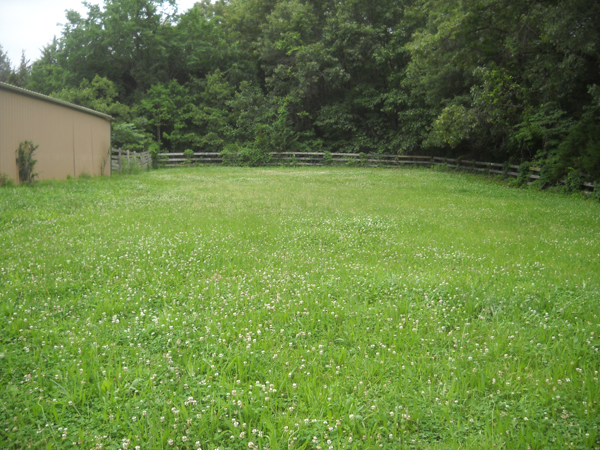
One of the horse pastures covered with weeds on May 31, 2015.

One of the horse pastures covered with weeds on May 31, 2015.

The same pasture on July 12, 2015, a month after application of weed killer.

The same pasture on July 12, 2015, a month after application of weed killer.

Post reviewed Sept. 13, 2026.

I can answer the question: Can you use weed killer on grass grazed by laminitic horses?

Yes.

Over three weeks in June 2015, I sprayed my whole farm using GrazonNext, which was recommended by my local feed store.

I have 8 fenced acres, plus 2 unfenced acres.

I sprayed the weed killer manually, walking around with a 2 gallon sprayer.

The feed store suggested I give the weed killer two hours of dry time before the next rainstorm hit. Given the fact that we had the wettest June ever, timing that out for each field was the hard part.

The cost for the weed killer and sprayer was less than $200, according to my memory, since the receipt has disappeared from my desk. Horse owners probably can find these products cheaper online, but I wanted the help of the feed store.

I wish I did this years ago, but I kept getting instructions from veterinarians that my horses should NOT eat grass. The last thing I thought I needed was good grass.

I’ve done a complete 180 on that. After I read equine nutritionist Juliet Getty’s post on how insulin resistant horses should be grazing all the time to turn around the disease, my goal is to ensure that the horses have great grass that they want to eat.

Research has shown horses on dry lots with weeds develop laminitis, though scientists often blame the weeds’ nonstructural carbohydrate level.

Veterinarian Frank Reilly warns that the high iron level in weeds can lead to insulin resistance.

My horses lived for years on dry lots with only weeds for nibbling, and the laminitic bouts happened over and over.

I won’t use fertilizer to improve the fields. Too many horse owners have reported their horses foundering right after pastures were fertilized. Perhaps the nitrogen in the fertilizer triggers the laminitis.

But I was willing to apply weed killer.

My farm in May 2015 was covered in weeds despite me mowing constantly. I was in panic mode when I went to the feed store for help on May 31.

GrazonNext is designed for pastures, and animals can go right back on the fields after the fields are sprayed, according to the maker.

I can’t swear 100 percent that it’s safe for horses to eat because my horses wouldn’t touch the vegetation after I sprayed it until after a few rainstorms.

I can say that we had no issues, other than some grumpy horse faces during the spraying process.

The feed store figured out how much I should use: 4 ounces per 2 gallon sprayer. A 2 gallon sprayer was supposed to cover 5,000 square feet (an area 50 feet by 100 feet).

I was fairly careful in measuring out the 4 ounces as I refilled the sprayer each time.

I didn’t measure off the feet I was spraying.

Within hours of spraying, the dandelions and other weeds keeled over.

GrazonNext won’t kill crabgrass, which is very high in iron. Some of my fields have patches of crabgrass, so we have some work left to do, but I’m really pleased with the fields, as are the horses.

I let the weed killer stay on the weeds about a week before I mowed (another recommendation by the feed store).

After the weeds died, it was much easier to mow the fields.

Some spots were left bare because only weeds had been growing in those areas. But we had a lot of rain in June and July, and those areas came back with grass, a big surprise to me. If the rain hadn’t been so well timed, the bare spots would have remained, I suspect.

I did a lot of research on this weed killer, because I wanted to spray it on the unfenced areas where deer and rabbits graze in the evening. The product appears to be safe for those animals, too. The deer and rabbits look unfazed.

I did notice one thing in my research that may matter to people who use manure to fertilize a garden. This weed killer has a residual effect. If a horse ingests plants with the weed killer on them, the pesticide will be in the manure and will still be active. If the manure is used on a garden, it will kill vegetables in the garden. Someone reviewing the product online said she found that out the hard way.

The feed store manager said I likely won’t have to apply the weed killer every year.

Some weeds have popped back up already, but they look dead on arrival. They don’t bloom. They just shrivel up.

I also have been applying lime to the fields.

Feed more hay to laminitic horse, equine nutritionist says

Posted on: June 14, 2015

Restricting Kurt's food intake has not reduced his girth.

Restricting Kurt’s food intake has not reduced his girth. Quite the opposite. During the first half of 2015, Kurt was given a flake of hay during the morning and evening and another overnight. He did have access to pastures, but there was no grass from January to March and the flies drove him into the shed from April to June (despite him being fly sprayed).


Post reviewed April 5, 2026.

Guilt drives a lot of my laminitis research. I’m always looking to clear my conscience. Did I cause my horses’ laminitis? Or did something else do so?

Since 1998, when my first laminitis case occurred, I’ve routinely paid vets to heap on more guilt. Each farm call has led to the same conclusion: My horses are obese; thus, I must be overfeeding them and causing the insulin resistance and laminitis.

Now, a new article suggests my horses are obese because I’m underfeeding them.

I’m still guilty, just of a different crime.

The article is written by equine nutritionist Juliet Getty, Ph.D., who makes her money consulting so she’s not going to go too far out on a limb unless she’s convinced she’s correct.

The article is titled, “Can the Damaged Insulin Resistant Horse Be Fixed?”

It’s long, and I’m just picking out a few things, but the whole article is worth reading at least twice.

Getty says we’ve created the insulin resistant horse by doing all the wrong things in the name of helping.

She urges owners to give horses free choice, low-carb hay, so horses eat constantly and slowly, as they were intended to eat. As in, horses should never be without hay.

To those, including me, who blurt out, “That’s going to cost a lot of money,” she says it will save money in the end because the horse will eat less. My horses poop on their leftover hay so I have issues there, but she would probably say I need to work on how I feed my horses.

She also suggests turning horses out on pasture (preferably after testing the sugar level in the grass, which I personally think is a waste of time since the sugar level in pasture rises and falls all day long).

Getty says, “Horses who graze on pasture 24/7 will eat far less grass than those who are only allowed to graze on pasture for a few hours each day, with hay provided the rest of the time.”

She includes caveats such as it might be good to ease a horse into having hay full time by using a couple of slow feeders that are always kept full.

She suggests not stalling a horse, which may be out of the question for a lot of horse owners, but Getty feels that’s a big factor for horse health.

Getty doesn’t address calories. I would argue that today’s hay seems to have an excessive amount of calories (about 2,000 calories per flake), but I’m guessing she feels a horse will stop eating when it has enough calories.

She concludes that the only way to fix an insulin resistant horse is to help it return to its natural state. She emphasizes that continuing down the same path of restricting food will get the same results: more insulin resistance.

I would add that it is possible to get a horse to lose weight by limiting its food and exercising it like crazy. But the result is temporary. The horse is not healthy, and adding a little more hay will make that horse balloon up.

Other factors that Getty mentions are addressing inflammation and lowering iron intake.

I worry that a horse with insulin resistance from excess iron may not improve if it is given free-choice hay and it continues to shovel in the hay. The horse may get worse.

My takeaway from the article is it needs to be embraced in its entirety. Helping an insulin resistant laminitic horse requires addressing all the possible issues that are causing the insulin resistance, not just forage intake.

Getty’s suggestions are revolutionary. She’s going against the advice of perhaps all leading laminitis researchers and vets.

Some of the top speakers at laminitis conferences have visited my farm (as friends of my former vet) and advised:

— Kill the grass on the pastures completely;
— Dry lot the horses on the existing paddocks and rent out the pastures to thoroughbreds (my horses would have loved that);
— Break up the 2-acre pastures into tiny pastures to limit access and improve the grass;
— Move.

Over the years, I found that restricting the horses’ food and dry lotting them made them fatter. And miserable. And the laminitis continued.

I refused to listen to laminitis researchers who were anti-grazing.

Horses closely related to my own were on bigger and much lusher pastures within a few miles of my farm, and those horses were thin and healthy. It convinced me that the grass itself was not the problem.

I wanted my horses walking constantly, covering a lot of ground, taking in a steady stream of forage and keeping busy.

In 2007, I fenced my two ungrazed lower fields (an additional 4 acres to the overgrazed 4 acres already fenced) and turned my remaining horses loose. I felt even more guilty, if possible, but at least my horses didn’t hate me. In the end, there was no uptick in laminitic cases. If anything, the bouts dropped.

I haven’t seen a groundswell of criticism of Getty’s article. But it is a study in contrasts with advice from other experts.

Kathryn Watts, retired plant scientist, creator of the safergrass.org website and a onetime hugely popular speaker, used to have a PDF on her consulting page that started out:

“If you insist on keeping an obese, non-exercised, laminitic horse on pasture at least 12 hours per day all year long … I cannot help you or your horse. My pasture management advice will include limiting grass intake, increasing exercise and completely eliminating access to pasture during periods when environmental conditions make it impossible to control grass sugar content by cultural practices. If you cannot or will not limit intake, it will be a waste of your money and my time to give you a complete pasture management program.”

Thehorse.com posted an article June 8, 2015, on feeding the laminitic horse that offers tips from Jennifer A. Wrigley, CVT, of New Bolton Center at the University of Pennsylvania. The school founded the now shuttered international laminitis conference in 2001.

Wrigley’s tips include restricting hay for the laminitic horse and perhaps dry lotting the horse.

Those of us who dieted heavily in our teens and 20s will attest to the counterproductive effect of restricting food intake. It makes one want food more. I never looked at the science behind why dieting made me crazy, but the craziness was undeniable. Getty has provided the science.

Laminitic horses already go through hell.

After reading Getty’s article, I realize we have been keeping our horses in that hell perpetually.

No guilt there.
Looking for the thrifty gene in laminitic horses

Posted on: November 18, 2012

Kurt and Robin are substantially overweight, whereas their nephew was skinny for years on a nearby pasture.

This post was reviewed on Sept. 13, 2026. It’s not terribly helpful, other than it tells us there’s still a lot we don’t know.

Kurt and Robin are substantially overweight (in mid-October 2012), whereas their similarly built cousin was skinny for years on a nearby pasture that was by all standards very green and lush.

I have often heard researchers refer to a “thrifty” gene in horses that develop laminitis.

Researchers say this gene may be the reason that some horses founder and some don’t. My farm is surrounded by pastures far larger than my own that are dotted with horses — some relatives of my horses — that haven’t foundered, so I’m skeptical of this thrifty gene, but it would explain some things.

I’ve heard a couple of laminitis researchers theorize that horses that traveled from Europe to America by boat as America was colonized had to be able to get by on little food to survive. The researchers suggested we owe the birth of our country to those horses’ thriftiness.

The website of the International Museum of the Horse used to include the history of the horse, and it painted a grim picture of Spaniards shipping their horses to the New World in the 1600s, and let’s remember that this was only 400 years ago. Hard to believe.

Apparently, horses were shipped in slings. This took their weight off their feet and allowed them to swing with the roll of the ship. The dark, damp atmosphere in the boats and lack of exercise often killed half the horses, and the dead animals were buried at sea. Some say this is how the section of the Atlantic Ocean named the Horse Latitudes got its name, though others say this is folklore.

Getting the horses off the ship was hazardous, as well. They were lowered by sling into the water and made to swim ashore by people in row boats.

Laminitis researchers suggest that the same thrifty genes that served horses well in hardship are now killing them because the improved grass and hay created for cows is too rich for the systems of these horses, and they develop laminitis (as do cows).

I would buy the thrifty gene theory more if I could explain why none of my parents’ Connemaras (the ancestors of my horses) foundered. Similarly, I don’t know of any siblings of my horses that have foundered, though many live on pasture. My mare Angel moved to my current farm as a 3-year-old in 1997 and got very fat in a year. I sent her to Ohio for three years as a broodmare, and immediately she dropped a tremendous amount of weight, even though she got pregnant. She was stalled some of the time but she also got out on pasture each day. I don’t think her access to grass there was much different than her life at my farm, because, here, she had almost no grass, sharing a 2-acre pasture with four other horses round the clock. One could argue she got more grass while away. She was very thin when she returned home from Ohio at the end of 2001. She got fat and foundered by February 2004, a little over two years later, in the middle of winter even as I worried about laminitis from having problems with my other horses and tried to maintain an appropriate diet for all of the horses.

At any rate, I’ve been searching online for this equine thrifty gene. Mostly, it seems like the thrifty gene is a theory, and scientists are trying to find which gene is the culprit.

I saw a few references to a likely thrifty gene in an article by laminitis researcher Philip Johnson at the University of Missouri’s vet school. He wrote the article in 2009 for the Journal of Diabetes Science and Technology.

Johnson’s article covers the fact that horses that evolved naturally would go through the process of putting on excess weight during the fall in the form of stored fat to get through harsh winters.

He says herbivores, including horses, contain a critical survival mechanism — increased secretion of proopiomelanocortin (POMC) peptides in the fall — that stimulates the appetite and leads to other changes that result in fat storage in preparation for winter, when food tends to be relatively scarce.

This short-term addition of fat was fine historically. Johnson says it’s the chronic persistence of fat that leads to problems, and owners today generally keep their horses too fat.

He talks about how wild horses survived by covering a great distance daily to find little grass that was relatively low in sugar. He says today there is good evidence that providing higher sugar rations leads to diminished insulin sensitivity.

Higher sugar combined with less exercise and “grossly excessive” feed rations is what is getting horses in trouble today, he says. And he points out that today’s forage is designed to make farm animals gain weight quickly.

He says there are few statistics on current horse obesity, but one study found 45 percent of 319 randomly selected horses to be fat or very fat. That compares to 25.8 percent rate of obesity in cats and 25.2 percent rate in dogs, he says. I’ve seen other numbers that put cat and dog obesity much higher in 2012.

Johnson points out that laminitis is seen in two forms: one that leads to separation of the hoof lamellar interface, the tissue that connects the hoof to the bone inside the foot; and one due to chronic remodeling of the foot resulting from endocrine disorders (others have compared this remodeling to cancer-like growth).

Johnson says the endocrine abnormalities that are most often seen in horses with chronic laminitis are insulin resistance and excessive levels of corticosteroids. He says insulin resistance is likely an important component of thriftiness — horses with insulin resistance can survive on far less food.

As for corticosteroids, the corticosteroid named cortisol, a glucocorticoid due to its role in sugar metabolism, is secreted by the adrenal glands. Its primary roles are to increase blood sugar, suppress the immune system and aid in metabolism. Stress can lead to elevated cortisol levels, which can lead to weight gain.

Johnson said that an enzyme called 11-hydroxysteroid dehydrogenase-1 (11-HSD1), which converts inactive circulating cortisone to cortisol in localized tissue, is an important component of human metabolic syndrome and it is seen in increased amounts in the hoof lamellar interface (the connective tissue between the hoof and the bone) in laminitic hooves as well in the cresty necks of horses with equine metabolic syndrome. He said this enzyme is likely one of these thrifty genes.

Johnson also reviews the fact that insulin itself is toxic to the hoof lamellar interface, and raising a horse’s insulin level can result in laminitis.

My feeling is that, yes, all of these thrifty genes may behave in a way that leads to laminitis, but something has to trigger them to behave in that manner. If horses of similar genetic background can live on grass nearby, what is triggering these thrifty genes to behave in a problematic manner in my horses? What is triggering them in the horses of others?

Should laminitic horses get a thyroid supplement?

Posted on: June 9, 2012

Kurt's sides are lumpy despite years of taking thyroid supplements to boost his metabolism.

Kurt’s sides are lumpy despite years of taking thyroid supplements to boost his metabolism.

Editor’s note on June 15, 2015: I wrote this post before reading Juliet Getty’s post on treating the insulin resistant horse. Thyroid supplement may help the laminitic horse lose a little weight, but I think it’s a poor substitute for helping a horse restore balance in its diet and life. Even before I read Getty’s post, I had taken Kurt off thyroid powder because it was making him break out in a drenching sweat. It took me a while to figure out the cause of the sweat. The day I stopped the thyroid powder, the sweat went away. Giving thyroid powder to a laminitic horse may cause unintended consequences. I’m leaving the article up, because the reporting of the research is accurate.

Laminitic horses often are put on the thyroid supplement levothyroxine sodium (commonly sold under the brand name Thyroid-L).

While it can be an effective component for treating the insulin form of laminitis, the reasons for using it have fluctuated over the years.

The thyroid is located in the neck of all mammals. The gland secretes the hormone thyroxine, or T4, and to a lesser extent triiodothyronine, or T3. These hormones predominantly affect metabolism, but they also influence growth, development and body temperature.

The pituitary gland and hypothalamus in the brain also play a role in regulating thyroid levels. The anterior pituitary gland releases thyrotropin, a thyroid stimulating hormone referred to as TSH. The hypothalamus releases thyrotropin releasing hormone, or TRH, which affects thyrotropin.

Low thyroid levels may be the result of problems in the thyroid, hypothalamus or pituitary gland, or all three.

According to Nat Messer, DVM, at an AAEP meeting in December 1998, hypothyroidism is uncommon in horses, but widespread misdiagnosis of thyroid dysfunction results in more than $750,000 worth of thyroid hormone supplement being sold for use in horses annually.

So, why have we been using thyroid supplements for laminitic and foundered horses? There was a time when laminitic horses that were “easy keepers” were presumed to have hypothyroidism because their body condition, particularly regional fat deposits, mirrored that of dogs with hypothyroidism, plus the horses had low or low-normal resting serum T3 and T4 concentrations.

But, in a 2006 proceedings paper for the AAEP, Nicholas Frank, DVM, admitted that scientists had come to realize that low thyroid levels were a consequence rather than a cause of the horse’s metabolic issues and may even be the result of use of phenylbutazone, or bute.

That surprised me. In more than 15 years of treating laminitic horses with bute, I was never told that bute might be lowering my horses’ thyroid levels.

Still, many owners of laminitic horses, including me, have been told to try thyroid supplement because it may help speed up the horse’s metabolism so the horse can lose weight, which hopefully will lower the horse’s risk for having a relapse of laminitis. Losing weight is often a battle for foundered horses because they are too lame to exercise and their food needs drop off dramatically due to the fact that they don’t move much.

I can tell you from personal experience that Thyroid-L doesn’t always help a horse lose weight — my horses got 2 grams of Thyroid-L a day for years, and they both were obese.

Where levothyroxine sodium does appear to help is with controlling insulin levels, though insulin’s role in laminitis was only solidified by research in 2007, so Thyroid-L may have been silently doing some good on the insulin front for years while being prescribed as a weight-loss treatment.

In a study published in 2008 in the American Journal of Veterinary Research, Frank said administration of levothyroxine sodium led to weight loss and increased insulin sensitivity in adult horses with healthy thyroid gland functioning. He also said levothyroxine sodium significantly increased the rate of insulin disposal.

Note that the amount of T3 and T4 in the bloodstream regulates the release of TSH by the pituitary gland, so low levels of T3 and T4, for whatever reason, make the pituitary release more TSH. There is no shortage of studies that talk about the link between a high TSH level and insulin resistance in humans.

In a German study published in 2000 in Clinical Endocrinology, researchers concluded that study subjects with normal thyroid function (euthyroidism) but elevated TSH were more obese, had higher triglycerides and an increased likelihood for metabolic syndrome, also known as insulin resistance syndrome.

The concern with the insulin form of laminitis is how much insulin and glucose is circulating in the horse’s bloodstream. If Chris Pollitt’s Australian research team is correct, elevated insulin levels in a horse can lead to the excess insulin in the blood errantly binding with the wrong receptors in a horse’s feet (insulin-like growth factor 1 receptors, rather than insulin receptors, which don’t appear to exist in horses’ feet), leading to out-of-control hoof growth, not unlike cancer, destroying the structure of the hoof wall, coffin bone and laminae.

If Thyroid L can lead to faster disposal of insulin, that alone might be a reason to add it to the diet of the laminitic horse.

At the same AAEP meeting in 1998, Messer addressed some additional factors that may affect thyroid levels, including nutrition. He said short periods of food deprivation can lower thyroid levels, as can diet composition.

Messer and associates conducted a study at the University of Missouri (published in 1995) in which food was withheld from six adult horses with normal thyroid function for four days. Hormone levels decreased more than 50 percent over that time. When the horses returned to a normal eating schedule, their thyroid levels returned to normal.

In a laminitic horse, thyroid levels might be lowered by bute and food deprivation, which are normal treatments for laminitis, and the resulting elevated TSH levels may increase insulin resistance. Elevated insulin would cause even more damage to the feet than had happened already. Given this scenario, it’s easy to see why owners might see some improvement giving a thyroid supplement to a laminitic horse.

Can laminitic horses eat carrots or not?

Posted on: February 18, 2012

This post was reviewed on Sept. 13, 2026. My last laminitic pony, now 30, now gets a lot of chopped-up carrots with no ill effects. I’m sorry that I restricted his carrot intake for so long, listening to so-called experts.

It appears there’s some controversy over the glycemic index of the carrot in the human world.

In one corner are those claiming that carrots have an unusually high glycemic index, and they should be avoided by those with insulin resistance.

In the other corner are the carrot backers, including the World Carrot Museum, trying to establish that carrots really are healthy and should not be shunned.

This might generate a snicker in some parts of the world, but to owners of laminitic horses, this is important stuff.

In my attempt to get to the bottom of this, I learned another concept related to glycemic index called glycemic load.

The glycemic index of a food indicates how quickly the carbohydrates in the food will raise your blood sugar. The higher the number, the faster your blood sugar rises. And then there’s the inevitable crash.

The glycemic index for each food is determined by testing people’s response before and after they eat the food.

The result is compared to a reference food, such as white bread or white table sugar, which sets the bar at 100. Food with a lower glycemic index than 100 causes blood sugar to rise more slowly than white bread or table sugar.

The glycemic index is determined for 50 grams of carbohydrates in the food. That’s the point that can’t be overlooked. One serving of a food may not have 50 carbohydrates in it.

The glycemic load factors in the amount of carbohydrates in the food for a more accurate number of how a food will affect your blood sugar.

The website Caring4Cancer by P4 Healthcare compares a carrot to white pasta for glycemic index and load.

It says that 50 grams of carrot carbohydrate has a glycemic index of 131, and 50 grams of pasta carbohydrate has a glycemic index of 71. Carrots seem pretty unhealthy by that number.

But, one carrot has only 4 grams of carbohydrates, while a cup of pasta has 40 grams.

Thus, the carrot’s glycemic load is 5.2, while that for the pasta is 28.

A glycemic load of 10 or less is considered low, and 11 to 19 is medium. Twenty or over is high and not good.

Several other knowledgeable websites back up this message. Carrots are indeed OK for those battling insulin resistance.

Phew.

We are killing our laminitic horses with calories

Posted on: November 9, 2011

Editor’s note on June 15, 2015:

I wrote this post before reading Juliet Getty’s post on treating the insulin resistant horse. I no longer think counting calories is a good way to treat a laminitic horse. However, the included material related to calories is correct.

—–

We are killing our laminitic horses with calories.

That’s my conclusion. I had been thinking I had been starving my chronically laminitic horses for years only to discover I wasn’t even close.

I spent some time on the phone in November 2011 with an expert in equine nutrition, Dr. Scott King, a veterinarian who is now the equine products manager at Bayer Healthcare in the Animal Health Division. He used to be in charge of new product development at the Purina division that overseas equine feed and before that he was a practicing large and small animal veterinarian, who happened to be my vet.

He was doing me a favor in answering a question on a topic unrelated to calories, but that was all that was on my mind that week, and the conversation eventually turned to the appropriate amount of calories, officially kilocalories, that a horse should eat.

He said he believes that a maintenance horse needs fewer calories than the NRC recommendation of 15,000 calories that I’ve been quoting. He says the maintenance calorie requirement is 13,000, and he studied low-calorie diets for horses extensively, so he should know.

Prior to this conversation, I had taken my hay into my local feed store to make sure I had the weight correct. Using a USDA-calibrated scale, my flake was about 2 14/16 pounds, and I rounded up to 3 pounds for ease of doing the math, since flakes vary in size anyway.

Dr. King said brome hay tends to average 800 calories per pound. My brome was a bit more at 880 calories. Alfalfa is 900 calories.

If I multiplied 880 calories by 3 pounds, I got 2,640 calories for one flake.

I told Dr. King I thought that was impossible, adding: “That means that, if it’s raining and I decide to throw my horses an extra flake of hay to keep them busy while they stand in their shed, I’ve just given them several thousand extra calories.”

He said that’s right. Referring to horse obesity, he said: “I believe it’s all about the calories.”

As noted previously, each of my two horses had been getting six flakes of hay per day, or 15,840 calories a day.

They also had been getting a total of 1 pound of Purina’s Nature’s Essentials Enrich 32 (I weighed that, too), which has 1,100 calories per pound.

And the horses got a carrot a day, which was roughly 50 calories.

For a grand total of 16,990 calories.

If a pound of fat is equivalent to 3,500 calories, and the horses were getting 3,990 extra calories a day by Dr. King’s standards, it didn’t take much to figure out why the 14-2 hand pony looked wide enough to be two ponies.

Dr. King recommended that I ride one at a walk and pony the other, since my efforts to make them do real exercise had failed due to mobility issues.

Note that all my horses foundered while in work, and a horse in work gets to eat considerably more calories..

Once a horse is foundered and cannot work, you definitely are dealing with a whole new meal plan, and likely most of us are overfeeding our laminitic horses immensely once they turn into lawn ornaments, thus cementing their fate as chronically laminitic horses for the rest of their lives.

Knowing what I’ve learned about how many calories are packed into a flake of seemingly harmless hay — what I once equated to a bowl of salad for humans — I now have to believe overeating played a major role in these recurring founder cases, even if I find out that excess iron or some other environmental factor gave the horses a big push.

Calories in hay and feed for laminitic and foundered horse

Posted on: November 7, 2011

A typical hay sample report shows the hay’s megacalories per pound in addition to the sugar and starch content. A megacalorie is 1,000 kilocalories, and a kilocalorie is what we know as a calorie. The rest of this article will use the familiar term of calorie.

My recent hay sample of brome hay says it has .88 megacalories, or 880 calories, per pound. If my horses are eating 20 pounds per day, they are getting 17,600 calories a day from their hay, which is wee bit over the 15,000 calories a day that the National Research Council is suggesting for a sedentary 1,000-pound horse, which might explain the big rolls of fat on my horses’ sides. For years with these hay results, I’ve been looking at the sugar and starch content to determine if I had the right hay. But, now I’m taking into consideration the calorie content, and the horses are getting too many calories. Reviewing my hay tests going back to 2004, the calories per pound all fall within a similar range. This particular hay is not extreme.

As for feed, the Animal Health Foundation, a laminitis research foundation, compiled the calorie amounts of many common equine feeds and distributed the list in 2007. I’m attaching a copy of that here since I can’t find it online. Most feeds have 1,000 to 1,500 calories per pound. My horses are getting a pound each of forage supplement.

The hay is particularly frustrating because my horses go through two flakes of hay at each of their three meals in no time and look at me as if I’m starving them. And, my strategy for exercising them has been to spread the hay out in several areas so they have to walk to get it. I can’t leave much of a pile in each place if I’m trying to stick to the two flakes per horse rule. And if I leave too small of a pile on a windy day, it just blows away. To find out that I’m 2,600 calories over their limit while struggling to stick to two flakes per horse per meal makes it all feel a little hopeless.

How many calories does your laminitic or foundered horse burn exercising?

Posted on: November 6, 2011

Editor’s note on June 15, 2015:

I wrote this post before reading Juliet Getty’s post on treating the insulin resistant horse. I no longer think counting calories is a good way to treat a laminitic horse. However, the included material related to calories is correct.

—–

The National Resource Council’s equine nutrition report, released in 2007, provides information on how much energy horses expend during exercise in addition to giving dietary requirements.

The NRC says that an 1,100 pound horse burns 5,000 calories if it trots for two hours. And the horse burns 2,000 calories if it walks for two hours.

Breaking that down a little bit, a horse trotting for one hour burns 2,500 calories. Trotting for 10 minutes works out to 417 calories. That’s pretty good for 10 minutes of work.

A horse walking for one hour burns 1,000 calories, and a horse walking for 10 minutes burns 167 calories.

By contrast, the average male running for an hour burns about 940 calories or 157 calories in 10 minutes, according to NutriStrategy.

Ten minutes is important in looking at laminitic horses, because some research suggests that 10 minutes of exercise a day is enough to lower a horse’s insulin level.

In 1992, researchers at the School of Veterinary Medicine at Louisiana State University reported that 10 minutes of exercise significantly reduced insulin resistance and helped ponies lose weight in as little as six weeks. The ponies were put on a treadmill and required to walk for one minute, trot for one minute and canter for eight minutes (hard to imagine making a pony canter on a treadmill). This was their only exercise. The rest of the time, they were stalled. The ponies lost a significant amount of weight during this time, changing body shape, losing girth size and seeing more muscle definition. Researchers noted that improved insulin sensitivity was maintained in the six weeks after exercise was stopped.

If your horse burned 417 calories in that 10 minutes, and everything else were kept equal, the horse would burn 2,919 calories a week.

To lose a pound of body fat, a horse must create a deficit of 3,500 calories, either from eating less or exercising more. If the horse burned an additional 2,919 calories a week trotting for 10 minutes every day, the horse would be pretty close to losing that pound.

If your horse needs to lose 200 pounds, 1 pound a week may not sound very helpful, but every diet has to start somewhere.

How many calories should you feed your insulin-resistant laminitic horse?

Posted on: November 5, 2011

Most owners of laminitic horses that have the insulin form of the disease are willing to move mountains to help their horse, but they don’t know where to turn. Often, they bring in the best farrier possible to try new shoeing techniques.

But the problem at least in part is related to the horse’s diet. Fix the dietary problem, and you have a much better chance of saving the feet.

Figuring out the content of what you’re feeding a horse is not an easy challenge. But some of this information is available. The process does require having your hay tested for content, as well as your grass, if your horses are on pasture.

The National Resource Council of the National Academies (top scientific minds in the country) released updated horse nutrition recommendations in 2007.

Horses’ food usually is assessed in megacalories. A megacalorie is 1,000 kilocalories, or calories as we refer to kilocalories in the human world.

The NRC says a 1,000-pound sedentary horse needs 15,000 calories a day of digestible energy, plus 1.2 pounds of crude protein, 18 grams of calcium and 13 grams of phosphorus. The numbers go up for a 1,200-pound horse to 18,000 calories, 1.5 pounds crude protein, 22 grams calcium and 15 grams phosphorus.

To lose a pound of body fat, an individual, including a horse, must create a deficit of 3,500 calories, either from eating less or exercising more. Generally, health officials suggest a person do this by reducing caloric intake by 500 calories a day for a loss of a pound a week. It seems reasonable that a horse could do the same since a horse gets a much bigger allotment of calories. But there are many challenges in pursuing that goal. There is no easy way to figure out how many calories a horse is eating. And a horse that is chronically obese apparently has a much more difficult time losing that weight than a horse that put on exess weight recently.

A study on iron overload and insulin resistance as it might relate to laminitic horses

Posted on: October 26, 2011

Since I wrote about iron and insulin resistance in horses two days ago, I stumbled over a paper by Dr. Eleanor Kellon that appears to have been created in 2006. The title is “Iron status of hyperinsulinemic/insulin resistant horses.”

Kellon conducted a study to determine if insulin resistant horses and ponies also show iron overload in their blood.

Insulin resistant horses and ponies were divided into two groups: those that received a balanced mineral diet and those that ate whatever minerals crossed their path. Another group of adult horses and ponies free of obvious disease served as controls.

There was a significant elevation in body iron in the insulin resistant horses on uncontrolled mineral intakes.

Kellon says: “Risk factors for equine insulin resistance have not been completed identified but likely represent an interaction between genetic predisposition, underlying disease states and the environment. Since genetic factors are beyond our control and drug therapy for PPID (Cushing’s) does not necessarily lead to resolution of IR, identifying external factors has the potential to improve control. The role of iron overload as a risk factor for IR and therapeutic effect of lowering body iron levels has been documented in man.”

And she concludes: “Animals on mineral balanced diets had normal TSI and ferritin levels, and improvement in their insulin resistance, but since other measures were undertaken concurrently (e.g. reduction in NSC of the diet), the effect of the mineral balancing per se could not be determined. More extensive prospective and intention to treat studies are necessary to clarify the role iron might play in equine IR.”