Category: Hoof care

Mastitis treatment clears up frog infections in horse foot

Posted on: November 18, 2022

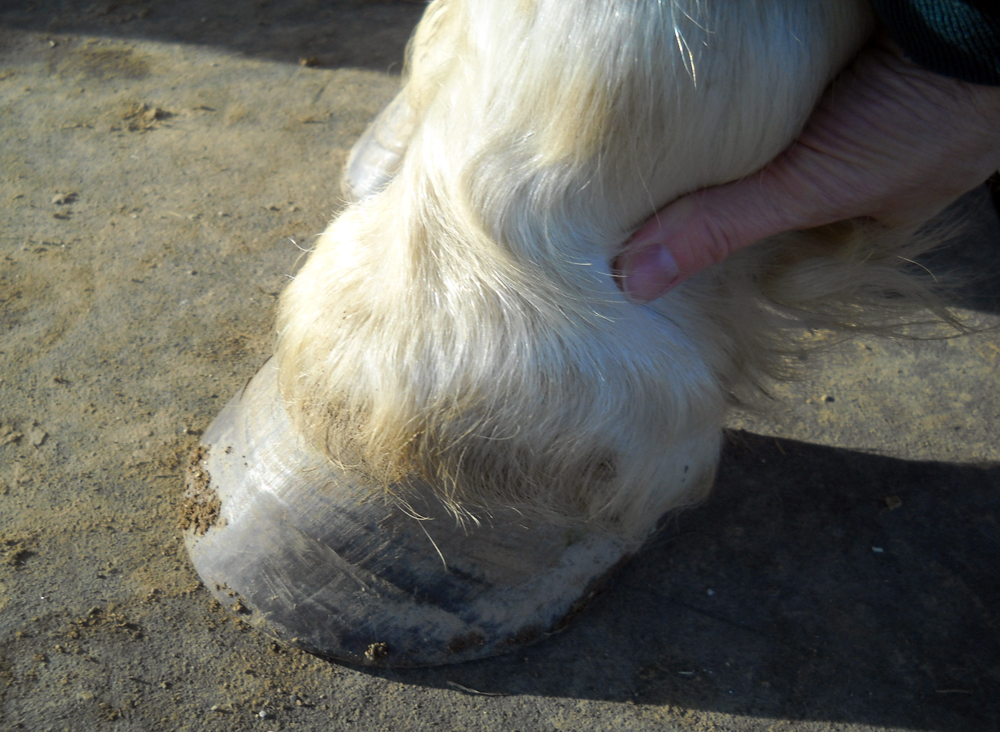
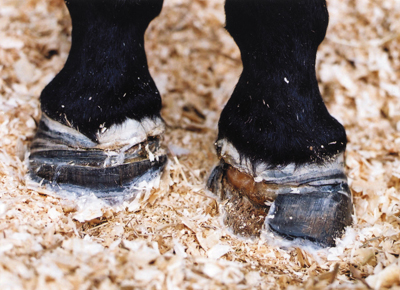
August 2022 was the third August in a row in which Kurt, 26, developed an infection in the frogs of all four of his feet.

This time, I applied a drug for cow mastitis to his frogs, and that seemed to fix the issue.

I thought this summary of our experience might help someone else.

There were no physical changes in Kurt’s frog during the summer. No wet area. No deep crack. No smell.

In mid-August, he started moving less and put his feet down toe heel. Watch the video to see that toe-heel placement (it’s the third clip in the series of clips).

Standing still, Kurt looked fine. Grazing, he could lean over his front toes and look as normal as any horse. I’ve never seen a horse having an active bout of laminitis lean over its toes.

This wasn’t a new bout of laminitis, though it likely was the result of compromised hoof walls from Kurt having chronic laminitis since at least 2010.

A study by Susan Kempson and Elaine Campbell at the veterinary school at the University of Edinburgh found that horn considered to be of poor quality had a weaker permeability barrier than horn of good quality.

Thus, laminitic hooves that no longer have good horn would not be moisture proof, as typical hooves are. This would allow bacteria and fungus to reach sensitive tissue.

I thought I could prevent the frog infections this year by spraying Kurt’s frogs every day with a Listerine type product. His frogs looked fabulous all summer. They were not too hard or too soft. I could use a hoof knife on them; in the past, they have been too hard to trim with a hoof knife.

I was so confident in my plan that I wasn’t watching for any walking issues that would indicate a frog infection.

But Kurt has one other “tell” when it comes to the frog infections: He bites his heel bulbs. The worse the infections get, the more he bites his heel bulbs. This year, the biting reappeared in August and got worse as September arrived.

He’s been biting his heel bulbs occasionally going back to at least 2014. So I’m wondering how long he’s been getting these infections, and I haven’t known it because they’ve been masked by numbness from laminitis.

Since Laminil has knocked out the inflammation in his feet the past few years, Kurt is really feeling these infections now.

I put together the video to show Kurt’s response to treatment. The video starts with him sound, miraculously, in May 2022 despite April and May traditionally being bad months for him. That victory, I believe, is due to him being treated throughout the spring with Laminil IM, a therapy that stops inflammation.

The video shows Kurt still sound in late July.

Then, the video shows how Kurt’s walking went south with the frog issues and was at its worst in late September 2022 and early October.

I was panicking by that point.

Internet searches suggested that thrush is the most common infection in the frog and back of the hoof.

But thrush involves moisture, and the frog often smells.

August 2022 here was very dry after one big rain at the start of the month.

Kurt spent his daytime hours during August in his shed in deep shavings in front of several fans and an air cooler. If anything, I was worried his feet were too dry. He walked around his pastures at night. He was free to walk around during the day, but the flies made him want to stay in.

When the frog pain occurred a year earlier, in August 2021, I soaked Kurt’s feet every day. It took several tries to find the right soaking agent, but we succeeded in getting rid of the infections with a Listerine-type product, which is why I kept using it to spray his feet over the winter and through the summer.

This August, soaking did not help at all. I kept trying for five weeks. I first used the same Listerine-type product and, when that didn’t work, I tried (one at a time) Clorox, apple cider vinegar, and various other things.

He got worse.

Things looked pretty hopeless the last weekend of September, and he was starting to lie down a lot. I stumbled over a YouTube video by a farrier who said he used a mastitis product of penicillin mixed in sunflower oil to cure a bad frog infection.

Using Go-Dry on Kurt’s feet

I ordered a box of 12 tubes of a product called Go-Dry and tried it starting on Oct. 1.

Kurt was definitely better within 24 hours, continued to improve day by day, and was close to sound in a month. His right front took longer to heel than the other frogs.

There are other products with the same formula. I have no affiliation with Go-Dry, and I’m not promoting it over other options.

Go-Dry comes in a dewormer-like tube, though smaller, and I found one tube applied generously did two feet, so I used two tubes per day to do all four feet. One box of 12 tubes lasted six days.

Removing the cap was a bit of a puzzle. It came off if the whole tip was pushed to the side.

I applied Go-Dry in the central sulcus of each of Kurt’s frogs and collateral grooves next to his frogs, then spread it all over the heel area across both bulbs, along the hairline, and into the dimple area, rubbing it in for about 30 seconds.

I had no guidelines here. I was just winging it.

Apparently, Go-Dry’s usefulness in hoof issues is common knowledge to others. When I asked if the local feed store had any after I started using it, one employee there, a jumper rider, looked surprised at first because he knows I have no cows, then said, “Oh, for your horse’s hooves.”

Am I sure it was the Go-Dry that made my horse better? He improved the day after starting treatment and just kept improving.

The weather didn’t change. His diet didn’t change. His bedding didn’t change.

In 2020, I interpreted the toe/heel walking as his feet being too dry and tried moisturizing them for weeks. He got worse.

So I believe the sunflower oil was not what fixed the problem in 2022. I think it was the penicillin.

How do we proceed from here? I am not sure.

I don’t want the penicillin to become ineffective for these infections. I’m using Go-Dry on his feet twice a week right now. That will need to end.

Will he stay sound? Hope so.

How do we prevent the frog infections next year? Definitely looking for that answer.
Foam treatment helps laminitic horse with poor frog

Posted on: February 23, 2015

(The first clip is from October 28, and the last two are from December 26.)


Editor’s note added on Jan. 7, 2023: Read this post on using a mastitis drug for frog infections before you start experimenting with foam. The mastitis drug might be a lot more effective. It certainly worked for Kurt.

Editor’s note added on Feb. 28. 2021: This approach might help one in 50 laminitic horses, based on my experience since I wrote this, so I wouldn’t expect miracles. Perhaps the real lesson is that a small change in the loading of a laminitic foot can make a big difference, and it can be worth the time to experiment with different materials in different places on the bottom of a sore laminitic foot to see if you can provide some relief. But bear in mind that numbness can factor into laminitis, and a horse not loading a foot may be the result of numbness or partial numbness.


Heading into Thanksgiving 2014, my laminitic horse Robin Hood was getting more and more uncomfortable.

Trying to keep him alive seemed a little selfish, considering his condition.

In the previous months, I had been studying veterinarian Debra Taylor’s 2014 presentation on hooves, particularly the importance of the digital cushion and frog in supporting the back half of the foot, and I was concerned that Robin seemed pretty deficient in both. His shallow frog was bearing no weight as he walked, and its wavy shape made me think his digital cushion was compromised. My longtime solution of keeping Robin in boots with thick cushions was no longer enough to provide relief.

I decided to experiment with his boot inserts over the holiday weekend, and if I couldn’t make him better, we’d give up.

There’s been no shortage of experimentation with foam at this farm. My basement looks like a foam warehouse, and I thought I had tried it all in every configuration.

One thing working in our favor that weekend was Robin couldn’t put weight on his left front at all. Each time, I changed out his foam, he tried to put his foot down. If my treatment didn’t help, he immediately picked up the foot again. As feedback goes, that’s priceless.

Two hours into this process, I stumbled over a two-fold answer that provided a smidgeon of relief. And over the days and weeks that followed, Robin continually improved.

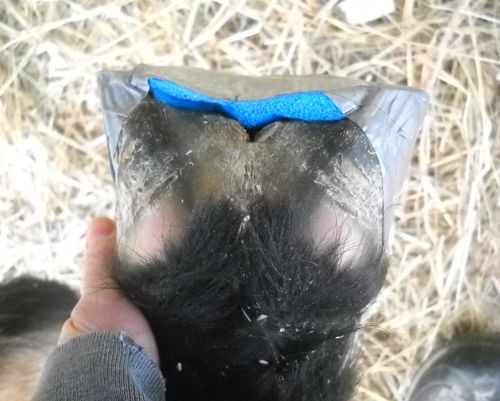
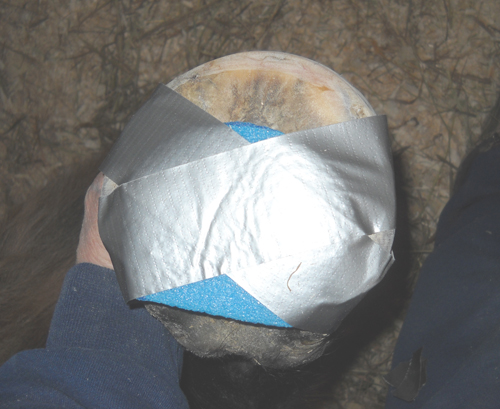
The foam is taped in place and does not extend beyond the tip of the frog. Two pieces of tape are showing in this image, but I also add one from the foam over the toe to prevent the foam from moving forward or backward.

The foam is taped in place and does not extend beyond the tip of the frog. Two pieces of tape are showing in this image, but I also add one from the foam over the toe to prevent the foam from moving forward or backward.

The first part of the answer was foam placement. In previous experiments, I had tried to raise the whole back of the foot, as a lily pad would do, by adding extra foam in the back of the boot. What I envisioned as added support translated to added pressure on Robin’s heels. That made him worse. This time, I left Robin’s heels outside the foam.

The foam is placed inside Robin's heels, covering the collateral grooves and sole along with the frog.

The foam is placed inside Robin’s heels, covering the collateral grooves and sole along with the frog. It starts out 1/2 inch thick but squishes down immediately.

foam frog pad

The foam fills in Robin’s collateral grooves along his frog.

The second part of the answer was the foam type. I experimented with a camping mat foam (Ozark Trails brand) sold at Walmart. To my surprise, Robin seemed to benefit from it filling in his collateral grooves next to the frog as it got squished down. This collateral groove support somehow relieved his pain.

To keep the foam in place, I’m taping it to Robin’s foot as opposed to placing it inside the boot, since the boot can move around. I change out the foam every day in each foot. He also still needs inserts in the base of the boot.

Also in the past, Robin did not like me adding a frog-shaped piece of foam over the frog. Again, what appeared to work this time was the foam dispersing in the collateral grooves.

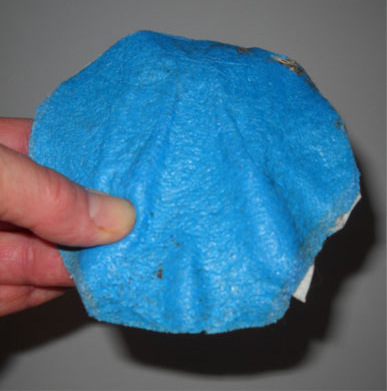
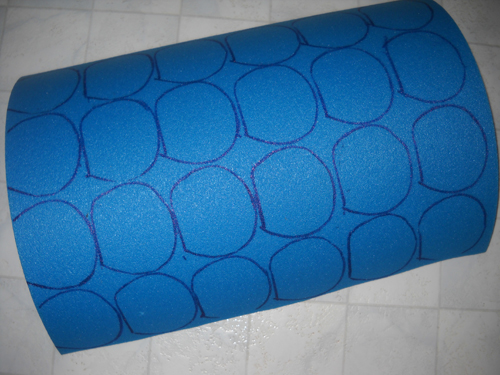
The shape of the foam insert has changed over time.

The shape of the foam insert has changed over time. I try not to cut out too many in advance in case I need to adjust.

We’ve tried to refine the foam pieces since Thanksgiving. Doubling the foam was a big no-no; Robin got less sound from that before we reverted to one layer. Robin is more comfortable if the piece does not go beyond the tip of the frog.

He’s more comfortable in general with longer heels, but now I’m seeing if lowering those long heels has any effect with the foam filling in the collateral grooves and perhaps lifting up his coffin bone.

He may need to wear the foam the rest of his life. I’m fine with that.

If your horse is deficient in frog or digital cushion and you can’t get the horse comfortable through trimming or other methods, you might try this. The cost is next to nothing.

Watch the video at the top of this page to see Robin’s movement before and after I added the foam.

No one was more surprised than I that this worked. Well, maybe Robin. He’s a trooper.

Vet examines why some laminitic feet return to soundness

Posted on: October 18, 2014

Some horses recovering from laminitis and coffin bone rotation become sound even though the hoof wall no longer is parallel to the bone. Dr. Debra Taylor, DVM, looks at possible explanations for this occurrence in a video posted on thehorse.com in September 2014.

Taylor is an equine podiatrist at Auburn University in Alabama.


Dr._Debra_Taylor


In Taylor’s 53-minute presentation, she discusses her journey in trying to come up with basic definitions for what constitutes a healthy equine foot and an appropriate physical exam of the foot.

Much of her presentation focuses on the back half of the foot and its soft tissue structures, more suited for absorbing concussion than the front half of the foot.

Taylor said she used to focus on the front of the hoof with laminitic horses, trying to regenerate normal parallelism between the hoof wall and coffin bone. When some of the horses became sound without parallelism, she asked herself: “What in the world are these horses walking on?”

One thing she saw was that increased heel volume seemed to play a role in a horse returning to soundness despite incomplete resolution of rotation. She hypothesized that increased heel volume might compensate for coffin bone remodeling or damage to the laminae.

She said hoof loading creates shock waves that are strong enough to crack a bone, but generally they don’t. They are absorbed through soft tissue. The front part of the foot has less soft tissue and is more rigid, making it more susceptible to shock waves. Taylor said a large frog and prominent heels are likely to play a significant role in cushioning hoof impact.

She credits farrier Pete Ramey with inspiring her to investigate the roles of the front and back of the foot. Ramey once commented that the coffin bone supports the front half of the foot and the digital cushion and lateral cartilages support the back half. She set about quantifying that ratio.

Taylor shows data on three feet comparing the size of the coffin bone in each to the size of the soft tissue structures. In the foot considered the healthiest, the lateral cartilages and digital cushion make up 159 percent of the area of the coffin bone. In the weakest foot, the soft tissue makes up less than 100 percent of the area of the coffin bone. Taylor said there’s a huge variation in nature and perhaps this type of comparison in a hoof can be useful in predicting whether the hoof is capable of taking care of that horse.

Taylor starts her presentation by talking about how horses’ feet are smart, changing in response to external factors. She wonders if the use of physical stimulation and physical therapy can create, or forge, the tissue needed for a healthy equine foot.

Working on grants, she realized there was no consensus on what a healthy foot looks like. Using several papers, she came up with the following description of a healthy foot. She provides 3-D models in her lecture to help illustrate.

Healthy hoof ratio

The foot should have more weight-bearing surface in the back half than the front using the widest part of the foot as a reference line.

Taylor does not review how to find the widest part of the foot. Some hoof experts suggest doubling the length of the central sulcus, or frog dimple, to reach the true apex of the frog, then measuring an inch back toward the heel to indicate the widest part of the foot. Farrier Gene Ovnicek provides an often-used hoof mapping protocol on his website.

Taylor said the front of the foot should be 40 to 50 percent of the weight-bearing surface of the foot and the back part of the hoof should be 50 to 60 percent of the weight-bearing surface of the foot.

Farriers who use this ratio often comment that most horses are trimmed with 60 to 70 percent of the weight-bearing surface out front of the widest part of the hoof, leading to too much pressure on the toe, prying apart of the laminae and painful abscessing.

Healthy frog dimensions

Taylor said the width of a frog should be 50 to 60 percent of its length. The depth should reach the ground, and there should not be a huge air cavity under the frog. The central sulcus, or dimple in the frog, should be wide and shallow without thrush. She shows an example of a heel that became healthier after she treated the frog for bacteria and fungus over a couple of months in muddy weather.

Healthy digital cushion

The digital cushion (a flexible layer of tissue that sits between the lateral cartilages and above the frog and cushions the back half of the foot), should be about 2 inches thick at the back of the foot and three to four fingers wide. She said veterinarians need instrumentation to evaluate the density of the digital cushion, perhaps a tool that would be similar to an A-shore scale measurement tool used to evaluate the density of rubber. She said the density of a digital cushion in decent feet is similar to that of a tennis ball or well-done steak. As for deformability, the digital cushion should have minimum deformability with maximum thumb pressure. She demonstrates how to palpate this tissue at the back of the foot. But she also said that the shape of the digital cushion as it tapers off toward front of the hoof may actually determine how effective it is in supporting the foot.

Healthy collateral cartilages

The collateral cartilages on either side of the digital cushion should be thick but slightly bendable with moderate thumb pressure and about 3 to 4 inches apart.

Healthy bars

The bars should end mid-frog and stand fairly erect. Taylor says to remove folded-over bars that may bruise the sole.

Coronary band circumference

Taylor says her team is finding that coronary band circumference is a good predictor of the volume of the internal structures. She did not provide more detail on that.

Healthy collateral grooves

She said her team was working on a paper on using the collateral grooves (the grooves alongside the frog) to predict coffin bone position. She said her team believed they would be able to use the slope of the collateral grooves to predict sole depth, coffin bone suspension off the ground, palmar angle, and maybe even heel development.

Ramey, the farrier, has done a lot of work in this area and describes the role of the collateral grooves as visual guides. On his website, he says the sole grows down from the bottom of the coffin bone. The sole corium, a bloody layer between the coffin bone and sole, is consistently a half inch away from the collateral grooves at their deepest part, no matter whether the rest of the sole is too thick or too thin. Thus, if a horse has a lot of sole, the collateral grooves will be deep. If a horse has little sole thickness, the collateral grooves will be shallow.

In Taylor’s lecture, she said the grooves gradually get deeper toward the back of the foot. The front hooves get deeper more quickly than the back feet. The collateral groove slope predicts palmar angle (the slope of the bottom of the coffin bone in the front feet). The palmar angle in the front feet averages about 6 degrees, while the angle (called the plantar angle) in the back feet is about 2 degrees.

She said an undulating, or wavy, collateral groove would be akin to a dropped arch in a human foot and cause discomfort, as would collateral grooves deeper at the frog apex, which would indicate a negative slope of the bottom of the coffin bone and warrant radiographs.

Taylor said horse feet can have pathology, even though a horse is sound, much like people can function normally even though they are on the verge of a heart attack. She thinks a lot of horses are in this state, on the verge of a hoof attack, and no one recognizes that there’s pathology in the foot.

She said she saw so many feet with pathology in her early experience that she believed such feet were normal until she learned more about the function of the foot.

In a nod to the barefoot movement, she said barefoot farriers are running ahead of science in their hypothesis that the back half of the foot is essential for overall hoof health and the back half is very smart, or adaptive.

She also quotes an ancient Greek horse expert in his day who said smooth surfaces lead to the detriment of the equine foot and horses should be stabled on cobblestone.

Taylor shows an equine foot that developed a healthy concave sole after walking on pea gravel. She said horses get addicted to shoes and hoof boots, and lack of necessary stimulation may hinder healthy development and healing of those feet.

How to trim a laminitic horse

Posted on: August 3, 2013

This article was reviewed and updated Jan. 12, 2026.

I dreaded updating it for years, which made me procrastinate updating everything else on the website. But I kept asking myself: What had I learned about trimming laminitic feet since I posted this in 2013? Would anything I say have value? I will put what I have learned at the top of the post,  followed by the suggestions from experts.

My rule No. 1: I agree with so many things on paper that completely fail when I apply them to my horses’ laminitic feet. Laminitic feet do not follow rules.

My rule No. 2: Not every laminitic foot is going to return to normal. Don’t believe every claim from people who say your horse’s foot will go back to normal if you follow their advice or use their product. Scar tissue inside a hoof isn’t likely to return to normal tissue.

I no longer try to trim the feet of my last living laminitic horse, Kurt, to a 50/50 proportion, as described below. I no longer try to develop a big healthy frog that hits the ground before the rest of the foot (some vets and farriers have said that’s a must). Both of those things make Kurt very sore. He is only happy and sound when his frog is not touching the ground, including when his foot is loaded. To those who scoff, Kurt could care less. He’d rather be sound.

I leave some heel. Too low of a heel puts pressure on Kurt’s deep digital flexor tendon, probably because his coffin bone has been tipped forward for so long.

I leave the sole flat from the tip of the frog forward to the toe wall. Kurt’s tip of his coffin bone is too close to that area for me to dream of him having a concave sole someday. It’s not going to happen.

I can’t get rid of all the stretched white line. Kurt protests if I try and gets sore afterward.

Wonder Dust is a good (and cheap) treatment for a stretched white line area. Best one I’ve tried.

Kurt’s front of his hoof wall on his two front feet does not grow down. It grows forward. It will never touch the ground. I am still using a belt sander to sand that forward-growing wall back so his feet don’t get too long toe to heel. But, the part that always makes me pause is the side walls have to taper off as they approach the toe area where Kurt is walking on his sole. I make the junction one continuous surface (line?), even though it’s not one continuous wall from one side of the hoof around the front to the other side. The side walls look like off ramps to nowhere as they disappear around the toe area. Part of the issue is Kurt’s coffin bone sits a bit lower than in the normal hoof, pushing his sole lower, too. I can sand off the sole flat with the side walls because leaving it extended beyond the side walls makes Kurt sore. But the lower sole likely contributes to the toe wall not being firmly attached at the toe and that toe wall going its own way — in this case, forward.

I will look for a photo, but that’s the best I can do for a written description.

Tips from the experts

I put together the information below in 2013 after studying the websites of farriers Gene Ovnicek and Pete Ramey. These names are not new to anyone. These two farriers are highly regarded for providing instruction to others.

Using their concepts, I’ve tried to assemble what I hoped was a quick guide to understanding the hoof.

When it comes to laminitic feet, one can’t always aim for perfection without causing pain, Kurt has told me more than once.

Ovnicek’s Hoof Mapping Protocol

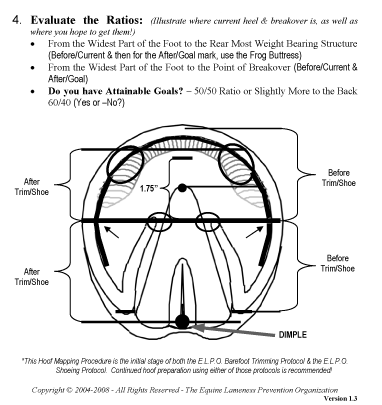
Ovnicek’s ELPO (Equine Lameness Prevention Organization) Hoof Mapping Protocol provides guidelines for assessing the foot. I am shortening his guidelines to give you some very simple principles, but you can find the full protocol by downloading the PDF.

elpoprotocol

This is a screen grab of Ovnicek’s mapping protocol. Click it to go to the full protocol.

I found it helpful to mark the bottom of a foot with a marker to learn all of these principles.

A properly trimmed hoof should have the same amount of hoof ahead of the widest part of the hoof as it has behind the widest part (or even 60 percent behind the widest part), according to this protocol. Most horses have 60 percent in front of the widest part.

To evaluate your horse’s foot:

Step 1: Find the widest part of the hoof.

For me, the following instruction has been the easiest way to do this:

Measure the length of the central sulcus, the dimpled area inside the frog, with a tape measure. Double that measurement along the frog to get the true apex, or tip, of the frog. So, for example, if the central sulcus is 1 1/2 inches, measure from the front tip of the central sulcus 1 1/2 inches forward on the frog to arrive at the true apex. Mark the true apex.

From the true apex, measure 1 inch toward the heel to get the widest part of the hoof. Draw a line across the hoof at this point.

Step 2: Find the tip of the coffin bone:

The tip of the coffin bone is approximately 1 3/4 inches in front of the widest part of the hoof. Measure from the line you drew for the widest part of the foot 1 3/4 inches toward the toe and draw a new line across the foot.

Step 3: Find the approximate point of breakover:

This is 1/4 inch in front of the tip of the coffin bone. Draw another line for the point of breakover.

If you’re looking for shortcuts when you’re working on your horse, you can find the point of breakover by measuring 1 inch in front of the true apex of the frog.

Step 4: Draw a line where the toe should end:

I was mistaken earlier in saying this is one gloved finger width in front of the point of breakover. The toe should fall just beyond the point of breakover. There doesn’t seem to be a fixed measurement here, but one gloved finger width might be a good maximum. Since this protocol calls for the white line area to be tight, it’s counterproductive to let the toe get long and stretched.

Step 5: Analyze your horse’s hoof:

If you have a lot of hoof in front of the line where the toe should end, you likely have some work to do.

Ramey’s theories on the dissent of the coffin bone

Ramey has assembled a page on understanding how and why the coffin bone drops in the foot.

He says the coffin bone often drops in horses, particularly sport horses, due to shoeing practices that force the hoof walls to bear all of the force of impact, creating more constant stress than the laminae were ever intended to withstand. Ideally, the hoof walls, soles, bars and frogs are supposed to work together to support the horse. Thus, the descent of the coffin bone is not just a problem for laminitic horses.

Ramey says the coffin bone can return to the proper position by moving higher in the hoof relative to the coronary band if the sole is allowed to grow properly.

Here are some of his concepts:

Ramey says all horse hooves are very consistent in their distance from the bottom of the collateral grooves (along the frog) to the bottom of the coffin bone, so we can use the grooves to judge where the coffin bone is inside the hoof without radiographs.

He says to put a rasp or ruler across the bottom of the hoof. Using another measurement tool, measure from the rasp or ruler to the bottom of the collateral groove at the tip of the frog and again from the rasp or ruler to the bottom of the groove near the heel.

In healthy hooves, this measurement should be around 3/4 inch at the tip of the frog and 1 inch toward the heel.

If this measurement is only 1/16th of an inch at the tip of the frog, the coffin bone is very close to the ground.

I personally find this measurement technique almost impossible to pull off, but I do study my horses’ grooves.

For more about sole thickness, visit Ramey’s page on understanding the horse’s sole.

So, what to do about a dropped coffin bone? Don’t touch the sole when trimming, especially any lumps in the sole, Ramey says.

Full disclosure: Lumps make Kurt sore, so I sand off the lumps.

Ramey says the hoof will build calluses around the coffin bone as the horse tries to grow healthy sole, and farriers who trim this lumpy area in trying to create concavity are actually thinning the sole and causing the coffin bone to drop even more. The sole needs to be loaded and unloaded with weight to grow, so it needs to come in contact with the ground. When the sole becomes thick enough, it will drive the coffin bone higher relative to the coronary band. As this happens, the sole will become concave on its own, and this concavity will be appear all the way to the edge of the wall. The sole creates its own concavity.

If there is flare in the wall, or a gap between the sole and hoof wall, this flared wall should be rasped off and the bottom of the hoof beveled, or sloped, from inside to out at 30 degrees, so only the inside of that bevel is touching the ground. If the hoof doesn’t have irreversible damage, this trim should allow the hoof wall to grow in with a tighter attachment. In the meantime, the horse needs to carry its weight on the sole rather than the wall and should be provided with boots with neoprene foam (according to Ramey) or insulation-type foam taped to the hoof (according to Ovnicek) to make it comfortable.

Ramey says he follows one big rule on how much to trim the hoof in the laminitic horse: He trims the walls and bars to 1/16th inch above healthy sole (assuming there’s healthy wall to trim), and lets the sole grow out.


Learn to check the digital pulse in a horse’s foot before laminitis develops

Posted on: December 11, 2011

Checking a horse's digital pulse.

Checking a horse’s digital pulse.

Checking the digital pulse in a horse’s foot is a handy skill to have. It’s good to establish what your horse’s pulse feels like prior to the horse having problems, such as laminitis or founder. If you call the vet and say, “I think my horse is foundering,” the first thing the vet will ask you is, “Does your horse have a pulse?”

There are two ways to position your hand, and preference really comes down to the size of your hand.

The process is similar to checking your own pulse using your wrist. To do that, turn your hand palm up and put your first two fingers on the outer edge of your wrist just beyond where your wrist meets your hand. Press lightly to feel your pulse. Everyone should be able to feel this pulse.

In a normal horse, it’s often difficult to find the digital pulse. That’s OK. At the same time, feeling a small pulse does not necessarily indicate that the horse has a problem.

Place your thumb and one or two fingers on the outer edges of the crease where the horse’s foot meets the ankle (see photo). If you have a long hand, you can reach around the front of the foot. Otherwise, just feel the ankle from the back of the foot.

Press a little, but not too much. Feel for the same type of pulse you feel in your own wrist.

The skill really is like anything else. If you do it enough, you get the hang of it.

Check the horse’s pulse at consistent times to get a feel for the normal pulse at those times. I have one horse with a much stronger pulse overnight than during the day. Note both the strength and rapidness of the pulse. Horses with an acute case of laminitis often have a rapid, pounding pulse. A normal pulse might feel very faint and deliberate if you can feel it at all.

Write down your description of the pulse in a place where you can find it if you need it.

Photo journal of horse with laminitis and founder in 2004

Posted on: December 6, 2011

My mare, Angel, had one of the worst laminitis cases that my vet in 2004 had seen, and laminitis is his specialty.

At the time, I had just gone through laminitis and founder with another mare, and it occurred to me that I should chronicle Angel’s case with photos, especially after abscesses appeared on both feet. The previous mare didn’t have abscesses. This was new territory for me. In fact, I pretty much had a heart attack when the first abscesses opened up around Angel’s coronary bands. It looked like her hooves would fall off. And, as time wore on, most of the hoof wall did.

angelfeet

Angel’s damaged hoof wall eventually sloughed off.

This journal was designed for print, and I didn’t make any effort to control the file size when I made it, so it’s a whopping 300 megabytes in its original form. It took me a while to get it down to under 4 megabytes. And you can still read it. I think that’s as good as we’re going to get. You may have to zoom out a little to fit it all on your screen.

I laid it out vertically for print, not ideal for Web viewing because you have to keep scrolling up and down. But, it’s a good case study.

Angel did return to various levels of soundness over the years, but she often did too much once she was sound, running around with her herd mates, and then was left with more damage.

If I had known insulin resistance was the cause, we could have combatted the problem back in 2004 and perhaps turned this around. Angel likely ran extremely elevated insulin levels and suffered the abnormal hoof proliferation for all seven years after her original acute laminitis case, right up until she finally had to be put down in May 2011.

This diary is 15 pages, and the photos of the abscesses start on Page 4.

Boot inserts for laminitic and foundered horses

Posted on: October 14, 2011

If you use any sort of therapeutic boot on your laminitic or foundered horse, I think I’ve found a good solution to the problem of the inserts always wearing out.

I spent months testing material at a company called McMaster-Carr, and the 1/4-inch neoprene rubber appears to be a winner as a basic insert.

You can order online. The material is shipped the same day, so you likely will have it the next day. Return the product if it isn’t what you needed.

The right material needs to be thin enough that it doesn’t add weight to the boot but thick enough not to fall apart. It needs to have some cushion for sore horses but again not fall apart. And it needs to have enough stiffness that it won’t bunch up under the horse’s foot.

What worked perfectly for Robin in 2012 was a medium-strength neoprene rubber plain back, 3/16-inch thick, 12-by-24 inch and 40A durometer (which is medium soft) for $19.74.

The website is www.mcmaster.com, and you can order by phone if it’s too confusing.

I have since tried the 1/4 inch thickness in the same material and liked it, too. And when Robin’s feet got sore recently, we went with 1/2-inch thick neoprene foam on top of the thinner neoprene rubber.

I have no affiliation with this group. I love its service, and I’m not spending $10 to $70 for boot inserts when I can get eight for $20. I thought others might share my concern for the cost of equine boot inserts.