How to trim a laminitic horse
This article was updated Jan. 12, 2026, and reviewed April 5, 2026.
I dreaded updating it for years, which made me procrastinate updating everything else on the website. But I kept asking myself: What had I learned about trimming laminitic feet since I posted this in 2013? Would anything I say have value? I will put what I have learned at the top of the post, followed by the suggestions from experts.
My rule No. 1: I agree with so many things on paper that completely fail when I apply them to my horses’ laminitic feet. Laminitic feet do not follow rules.
My rule No. 2: Not every laminitic foot is going to return to normal. Don’t believe every claim from people who say your horse’s foot will go back to normal if you follow their advice or use their product. Scar tissue inside a hoof isn’t likely to return to normal tissue.
I no longer try to trim the feet of my last living laminitic horse, Kurt, to a 50/50 proportion, as described below. I no longer try to develop a big healthy frog that hits the ground before the rest of the foot (some vets and farriers have said that’s a must). Both of those things make Kurt very sore. He is only happy and sound when his frog is not touching the ground, including when his foot is loaded. To those who scoff, Kurt could care less. He’d rather be sound.
I leave some heel. Too low of a heel puts pressure on Kurt’s deep digital flexor tendon, probably because his coffin bone has been tipped forward for so long.
I leave the sole flat to very slightly concave from the tip of the frog forward to the toe wall. Kurt’s tip of his coffin bone is too close to that area for me to dream of him having a visibly concave sole someday. It’s not going to happen.
I can’t get rid of all the stretched white line. Kurt protests if I try and gets sore afterward.
Wonder Dust is a good (and cheap) treatment for a stretched white line area. Best one I’ve tried.
Kurt’s front of his hoof wall on his two front feet does not grow down. I think what is really going on is his sole at the very front sits below the toe wall. Not a life ender, mind you. Just a complicating factor for trimming. I trim the sole flat with the hoof wall sides. I can’t get it flat with the toe with the toe wall not being there.
The toe wall grows forward, for lack of a better description, as the white line area stretches. The toe wall will never touch the ground.
I am still using a belt sander to sand that forward-growing wall back so his feet don’t get too long from the toe to the heel. But, the part that always makes me pause is the side walls have to taper off as they approach the toe area where Kurt is walking on his sole. I make the junction one continuous surface (line?), even though it’s not one continuous wall from one side of the hoof around the front to the other side. The side walls look like off ramps to nowhere as they disappear around the toe area.
I will look for a photo, but that’s the best I can do for a written description.
Tips from the experts
I put together the information below in 2013 after studying the websites of farriers Gene Ovnicek and Pete Ramey. These names are not new to anyone. These two farriers are highly regarded for providing instruction to others.
Using their concepts, I’ve tried to assemble what I hoped was a quick guide to understanding the hoof.
When it comes to laminitic feet, one can’t always aim for perfection without causing pain, Kurt has told me more than once.
Ovnicek’s Hoof Mapping Protocol
Ovnicek’s ELPO (Equine Lameness Prevention Organization) Hoof Mapping Protocol provides guidelines for assessing the foot. I am shortening his guidelines to give you some very simple principles, but you can find the full protocol by downloading the PDF.
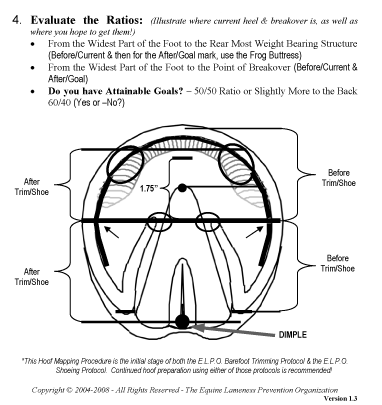
This is a screen grab of Ovnicek’s mapping protocol. Click it to go to the full protocol.
I found it helpful to mark the bottom of a foot with a marker to learn all of these principles.
A properly trimmed hoof should have the same amount of hoof ahead of the widest part of the hoof as it has behind the widest part (or even 60 percent behind the widest part), according to this protocol. Most horses have 60 percent in front of the widest part.
To evaluate your horse’s foot:
Step 1: Find the widest part of the hoof.
For me, the following instruction has been the easiest way to do this:
Measure the length of the central sulcus, the dimpled area inside the frog, with a tape measure. Double that measurement along the frog to get the true apex, or tip, of the frog. So, for example, if the central sulcus is 1 1/2 inches, measure from the front tip of the central sulcus 1 1/2 inches forward on the frog to arrive at the true apex. Mark the true apex.
From the true apex, measure 1 inch toward the heel to get the widest part of the hoof. Draw a line across the hoof at this point.
Step 2: Find the tip of the coffin bone:
The tip of the coffin bone is approximately 1 3/4 inches in front of the widest part of the hoof. Measure from the line you drew for the widest part of the foot 1 3/4 inches toward the toe and draw a new line across the foot.
Step 3: Find the approximate point of breakover:
This is 1/4 inch in front of the tip of the coffin bone. Draw another line for the point of breakover.
If you’re looking for shortcuts when you’re working on your horse, you can find the point of breakover by measuring 1 inch in front of the true apex of the frog.
Step 4: Draw a line where the toe should end:
I was mistaken earlier in saying this is one gloved finger width in front of the point of breakover. The toe should fall just beyond the point of breakover. There doesn’t seem to be a fixed measurement here, but one gloved finger width might be a good maximum. Since this protocol calls for the white line area to be tight, it’s counterproductive to let the toe get long and stretched.
Step 5: Analyze your horse’s hoof:
If you have a lot of hoof in front of the line where the toe should end, you likely have some work to do.
Ramey’s theories on the dissent of the coffin bone
Ramey has assembled a page on understanding how and why the coffin bone drops in the foot.
He says the coffin bone often drops in horses, particularly sport horses, due to shoeing practices that force the hoof walls to bear all of the force of impact, creating more constant stress than the laminae were ever intended to withstand. Ideally, the hoof walls, soles, bars and frogs are supposed to work together to support the horse. Thus, the descent of the coffin bone is not just a problem for laminitic horses.
Ramey says the coffin bone can return to the proper position by moving higher in the hoof relative to the coronary band if the sole is allowed to grow properly.
Here are some of his concepts:
Ramey says all horse hooves are very consistent in their distance from the bottom of the collateral grooves (along the frog) to the bottom of the coffin bone, so we can use the grooves to judge where the coffin bone is inside the hoof without radiographs.
He says to put a rasp or ruler across the bottom of the hoof. Using another measurement tool, measure from the rasp or ruler to the bottom of the collateral groove at the tip of the frog and again from the rasp or ruler to the bottom of the groove near the heel.
In healthy hooves, this measurement should be around 3/4 inch at the tip of the frog and 1 inch toward the heel.
If this measurement is only 1/16th of an inch at the tip of the frog, the coffin bone is very close to the ground.
I personally find this measurement technique almost impossible to pull off, but I do study my horses’ grooves.
For more about sole thickness, visit Ramey’s page on understanding the horse’s sole.
So, what to do about a dropped coffin bone? Don’t touch the sole when trimming, especially any lumps in the sole, Ramey says.
Full disclosure: Lumps make Kurt sore, so I sand off the lumps.
Ramey says the hoof will build calluses around the coffin bone as the horse tries to grow healthy sole, and farriers who trim this lumpy area in trying to create concavity are actually thinning the sole and causing the coffin bone to drop even more. The sole needs to be loaded and unloaded with weight to grow, so it needs to come in contact with the ground. When the sole becomes thick enough, it will drive the coffin bone higher relative to the coronary band. As this happens, the sole will become concave on its own, and this concavity will be appear all the way to the edge of the wall. The sole creates its own concavity.
If there is flare in the wall, or a gap between the sole and hoof wall, this flared wall should be rasped off and the bottom of the hoof beveled, or sloped, from inside to out at 30 degrees, so only the inside of that bevel is touching the ground. If the hoof doesn’t have irreversible damage, this trim should allow the hoof wall to grow in with a tighter attachment. In the meantime, the horse needs to carry its weight on the sole rather than the wall and should be provided with boots with neoprene foam (according to Ramey) or insulation-type foam taped to the hoof (according to Ovnicek) to make it comfortable.
Ramey says he follows one big rule on how much to trim the hoof in the laminitic horse: He trims the walls and bars to 1/16th inch above healthy sole (assuming there’s healthy wall to trim), and lets the sole grow out.